iCommerce Engine: An Architectural Blueprint for Autonomous Commerce Operations
A technical blueprint for deploying autonomous commerce outcomes with the StateSet iCommerce Engine.

Dominic Steil
Founder & CEO
iCommerce Engine: An Architectural Blueprint for Autonomous Commerce Operations
StateSet Technical Whitepaper
Version 1.1 · July 21, 2025
Author: Dominic Steil, Founder & CEO
Executive Summary
The StateSet iCommerce Engine is the autonomy backbone for modern commerce—turning fragmented, human-intensive operations into outcome-driven programs governed by measurable value. This summary equips executives with the signals required to evaluate, adopt, and scale iCommerce.
Executive Highlights
- Autonomy aligned to value: Outcome-based pricing, Value Assurance guardrails, and shared scorecards keep incentives locked to measurable business impact.
- Enterprise grade from day one: Temporal-backed orchestration, policy graph guardrails, and Sentinel oversight deliver explainable autonomy with audit-ready lineage.
- Weeks to confidence: Scenario Labs, Shadow Mode, and supervised autonomy deliver proof faster than legacy transformation programs while maintaining human control.
Key Metrics Snapshot
| Metric | Benchmark | Source |
|---|---|---|
| OPEX reduction | 30–50% | Composite customer cohort |
| Orders processed autonomously | Up to 98% | Post go-live AO scorecards |
| Gross margin uplift | 5–10% | Fulfillment optimization analytics |
| ROI | 1591% | $50M brand case study |
| Payback period | 0.7 months | Value Assurance ledger |
Reader’s Guide
This whitepaper is intended for leaders of digitally native brands and modern retail enterprises who are responsible for driving growth and operational excellence.
- Strategy & finance: Read the Executive Summary, Sections 4 and 4.6, then Appendix D for the Value Assurance scorecard.
- Operations leadership: Focus on Sections 3 and 4, plus the governance rituals in Section 6 and Appendix A’s deployment checklist.
- Technology & integration teams: Dive into Section 3, Appendix B, and the roadmap in Section 7 to understand extensibility and upcoming releases.
- Trust, risk, & compliance: Review Section 5, Section 6, and the glossary entries for Sentinel agents, AO contracts, and the Value Assurance Framework.
Table of Contents
-
- Introduction: The Operational Debt Crisis in Modern Commerce
-
- Defining the iCommerce Category: A New Operating System
-
- Architectural Deep Dive: The StateSet iCommerce Engine
-
- Implementation and Value Realization
-
- Security, Safety & Compliance: Designed for Trust
-
- The Governance & Control Plane
-
- 12-Month iCommerce Engine Roadmap (Q3 2025 – Q2 2026)
-
- Conclusion: The Future is Autonomous
-
- Glossary & Acronym Index
- Appendices & References
1. Introduction: The Operational Debt Crisis in Modern Commerce
Over the past decade, digital commerce has prioritized top-line growth and customer acquisition, often at the expense of back-office efficiency. The result is a compounding pile of operational debt—fragmented systems, manual processes, and incomplete data—that drags on margin and agility. As of 2025, the rise of AI-driven commerce and emerging channels such as TikTok Shop has intensified the pressure. Brands can no longer rely on incremental tooling; they need an outcome-native operating system.
McKinsey estimates that commerce organizations now spend 32% of their operating budget servicing legacy workflows—manual reconciliations, brittle integrations, and exception handling—up from 21% only five years ago. Brands that launch more than two new channels per year see error rates climb 3x unless they fundamentally re-architect operations. iCommerce addresses this systemic gap with an outcome-native operating system, not a patchwork of scripts.
1.1 The Anatomy of the Complexity Tax
Modern commerce operations depend on a patchwork of point solutions:
- Enterprise Resource Planning (ERP): Handles finance and inventory, often plagued by batch processing delays.
- Warehouse Management Systems (WMS): Manage fulfillment logistics with limited real-time context.
- Customer Support Platforms: Govern customer interactions but operate in silos.
- Payment Gateways & Fraud Prevention: Process transactions yet require manual exception handling.
- Third-Party Logistics (3PL) Interfaces: Connect to shipping partners with brittle integrations.
- Emerging Channels: Tie-ins to social commerce platforms such as TikTok Shop demand new policies and playbooks.
This complexity tax manifests as:
- Margin erosion: Inflated OPEX tied to licenses, maintenance, and BPO contracts.
- Fragility: Recurring breakdowns, data mismatches, and time-consuming manual resolutions.
- Growth impediments: Delays in product launches, market expansions, or channel additions without escalating complexity.
A day in operations looks fundamentally different with iCommerce:
| Time | Before iCommerce | After iCommerce |
|---|---|---|
| 8:00 AM | Log into five different systems to gather overnight data. | Review the iCommerce dashboard—98% of last night’s orders were processed autonomously. |
| 9:00 AM | Manually reconcile Shopify and the WMS after an oversell incident. | Inspect the 2% of orders automatically flagged for human review. |
| 11:00 AM | Pull a CSV of high-risk orders for the fraud team. | Receive Sentinel alerts with recommended actions already queued. |
| 2:00 PM | Chase a 3PL partner for a shipping update for an angry customer. | Monitor fulfillment trends surfaced by the Execution Plane. |
| 5:00 PM | Merge data from three platforms to build a report. | Spend the afternoon planning a new market expansion while the OS handles operations. |
1.2 The Failure of Incrementalism
Existing approaches are bandages, not cures:
- Point solutions add yet another silo and integration burden.
- iPaaS & automation tools handle simple, rules-based tasks but lack the contextual reasoning or adaptive learning needed for complex exceptions.
- Business Process Outsourcing (BPO) relocates the problem and adds latency without fixing broken processes.
A paradigm shift is required.
1.3 Outcome Operating Model
Unlocking iCommerce value requires thinking in outcomes, not tickets. The Outcome Operating Model aligns people, process, data, and financial guardrails around a single AO lifecycle:
- Sense: The Unified Data & Event Fabric captures raw signals, resolves entities, and tags intent so teams operate on a shared truth.
- Decide: Agent teams evaluate opportunities through policy, profit, and customer lenses before committing to action.
- Act: Orchestrated workflows execute deterministic steps, escalating to humans only when business rules demand it.
- Learn: AO telemetry, CX feedback, and financial impact loop back into prompts, policies, and product prioritization.
Leaders manage this model through a standardized scorecard: Autonomous Outcome Coverage (target ≥95% for steady-state flows), Decision Confidence Index (share of actions above threshold without rollback), Guardrail Adherence (policy overrides per 1,000 AOs), and Time-to-Value (weeks from Shadow Mode to first production AO).
1.4 StateSet’s Answer: The iCommerce Engine
The StateSet iCommerce Engine unifies data, workflows, and multi-agent intelligence across the enterprise. Four cooperative planes—experience, intelligence, execution, and data—ensure every action is context-rich, policy-aware, and economically aligned. Agents sense real-time events, reason with enterprise guardrails, take deterministic action, and learn from every outcome. Section 3 details the architecture behind the engine.
1.5 Why StateSet Wins
- Outcome-first economics: Pricing tied to delivered Autonomous Outcomes (AOs), not seats.
- Enterprise-grade controls: Temporal-backed orchestration, policy graph guardrails, Sentinel oversight, and explainability for every action.
- Rapid value creation: Scenario Labs, Shadow Mode, and supervised autonomy stages move brands from baseline to full automation in weeks, not quarters.
- Extensible ecosystem: Certified connectors, plug-in SDKs, and an Outcome Marketplace accelerate partner innovation without compromising data integrity.
1.6 Measured Impact
- OPEX reduced by 30–50% as redundant platforms and labor-intensive tasks are consolidated.
- Up to 98% of orders processed autonomously, compressing order-to-cash latency by >45%.
- 5–10% gross margin uplift delivered via fulfillment optimization and error elimination.
- AO scorecards track coverage, decision confidence, guardrail adherence, and payback—illustrated by the $50M brand case study delivering 1591% ROI with a 0.7-month payback.
1.7 Customer Momentum & Proof Points
- Top-50 DTC brand shifted from 14 disconnected tools to iCommerce in 11 weeks, unlocking 92% AO coverage and reclaiming 18 FTE equivalents for strategic growth.
- Luxury omnichannel retailer reduced chargeback losses by 63% after Sentinel policy enforcement flagged high-risk orders before fulfillment.
- Global nutraceutical company launched three new international storefronts without adding headcount, leveraging Outcome Marketplace plug-ins for localized tax, fulfillment, and CX policies.
1.8 Strategic Commitments
- Customer-led roadmap: Outcome Council reviews ensure roadmap priorities reflect real-world operational demands.
- Release discipline: Every launch ships with AO migration guides, policy diffs, Sentinel regression results, and rollback plans.
- Sustainable autonomy: The Value Assurance Framework keeps AO economics aligned with executive expectations, with corrective sprints triggered if value dips.
1.9 Programmatic Path to Autonomy
Transitioning to autonomy requires trust. Our activation blueprint proves value in weeks while keeping operators in full control.
- Stage 0 – Readiness & Data Audit: Run Scenario Labs, confirm data contracts, and capture AO baselines with zero production impact.
- Stage 1 – Shadow Mode: Agents observe and propose actions with explainability traces so teams can compare decisions before execution.
- Stage 2 – Supervised Autonomy: Low-risk AOs run with human approval, confidence thresholds, and kill switches exercised until teams are ready.
- Stage 3 – Programmatic Expansion: High-confidence domains move to full autonomy with Sentinel monitoring while new workflows enter the readiness loop.
This whitepaper provides the definitive architectural blueprint for the StateSet iCommerce Engine. It details the technology, security, and governance that enable autonomous commerce, offering a clear roadmap for leaders ready to eliminate operational debt and build a resilient, scalable, and profitable future.
2. Defining the iCommerce Category: A New Operating System
The StateSet iCommerce Engine is the reference implementation of the iCommerce category, replacing fragmented stacks with a unified, intelligent, autonomous engine. Instead of selling seats or features, StateSet delivers outcome-priced autonomy that turns operations from a cost center into a strategic advantage.
2.1 The Six Foundational Laws of iCommerce
- Intelligent: AI-native agents reason, interpret context, and self-learn beyond static rules.
- Integrated: Unifies all operations in a single, real-time system, abstracting away silos.
- Instant: Event-driven architecture enables autonomous execution without human or batch delays.
- Invisible: Abstracts back-office complexity, freeing human teams for high-value strategic work.
- Iterative: Continuously improves through a data-driven feedback loop.
- Impactful: Value is directly tied to business outcomes, not seats or feature bundles.
2.2 What iCommerce Is—and Is Not
| Attribute | What iCommerce Requires | What Is Not iCommerce |
|---|---|---|
| Intelligent | Agents reason, self-learn, and drive outcomes | Rules-based triggers and static automations |
| Integrated | Operations unified in one system | Standalone apps and batch jobs |
| Instant | Real-time, autonomous execution | Delayed, manual operations |
| Invisible | Complexity abstracted from operators | Human firefighting and swivel-chair work |
| Iterative | Continuous improvement and learning loops | Static scripts with no feedback |
| Impactful | ROI-based pricing tied to outcomes | Seat- or feature-based pricing models |
2.3 The iCommerce Maturity Ladder
- Stage 0 – Fragmented: Disconnected systems, human triage, no shared metrics. Goal: establish data contracts and governance sponsors.
- Stage 1 – Instrumented: Shadow agents run with explainability; AO analytics baseline established and policies codified. Success: ≥10% AO coverage in supervised mode.
- Stage 2 – Autonomous Core: High-volume domains (orders, CX) fully automated with Sentinel monitoring; humans focus on exceptions. Success: ≥80% AO coverage with <0.5% rollback rate.
- Stage 3 – Autonomous Enterprise: Finance, planning, logistics, and revenue functions coordinated by multi-agent swarms with co-pilot interfaces. Success: AO profitability uplift >7% YoY plus zero Sev-1 incidents.
- Stage 4 – Adaptive Network: Ecosystem partners integrate via the Outcome Marketplace, enabling cross-brand optimization and shared intelligence. Success: New AO types launched quarterly with <4-week lead time.
2.4 Outcome Benchmark Portfolio
Every deployment assembles a benchmark pack combining operational, financial, customer, and governance metrics so stakeholders can validate progress:
- Operational: Order cycle compression (target 45% reduction), first-contact resolution rate (≥92%), demand forecast accuracy (MAPE ≤8%).
- Financial: Gross margin lift (5–10%), AO cost variance (<5% deviation from plan), cash conversion acceleration (DSO improvement ≥3 days).
- Customer: CSAT uplift (+12 points), NPS delta (+8), subscription retention (+5%).
- Governance: Policy breach count (0 critical per quarter), model audit completion (100% of releases documented), explainability coverage (100% of high-impact AOs with decision trace).
Publishing these benchmarks in the Trust Console keeps the program accountable and gives executives a single view of value realization.
2.5 Comparative Landscape: Legacy vs. iCommerce
| Dimension | Point Tools / iPaaS | BPO / Managed Services | StateSet iCommerce Engine |
|---|---|---|---|
| Decision Quality | Static rules and scripts; no shared memory | Human judgment; inconsistent playbooks | Multi-agent reasoning with guardrails, shared memory, and continual learning |
| Speed to Value | Months of brittle integration projects | Weeks to train staff; limited leverage | Scenario Labs + Shadow Mode deliver value in 2–4 weeks |
| Cost Structure | License + integration + hidden maintenance | Labor-heavy, linear cost curves | Outcome-based pricing aligned to realized AOs |
| Governance & Trust | Minimal auditability; limited policy control | Manual procedures, hard to audit | Policy graph, explainability, Sentinel monitoring, immutable logs |
| Scalability | Struggles with channel proliferation & peak demand | Requires staffing surges | Elastic orchestration, auto-scaling connectors, self-healing workflows |
| Innovation Pace | Vendor-led roadmap; customization costly | Process redesign slow & expensive | Marketplace extensions, plug-in SDKs, rapid AO launch cadence |
This comparison highlights why incremental automation cannot keep pace with modern commerce complexity and why an outcome-native OS is required.
3. Architectural Deep Dive: The StateSet iCommerce Engine
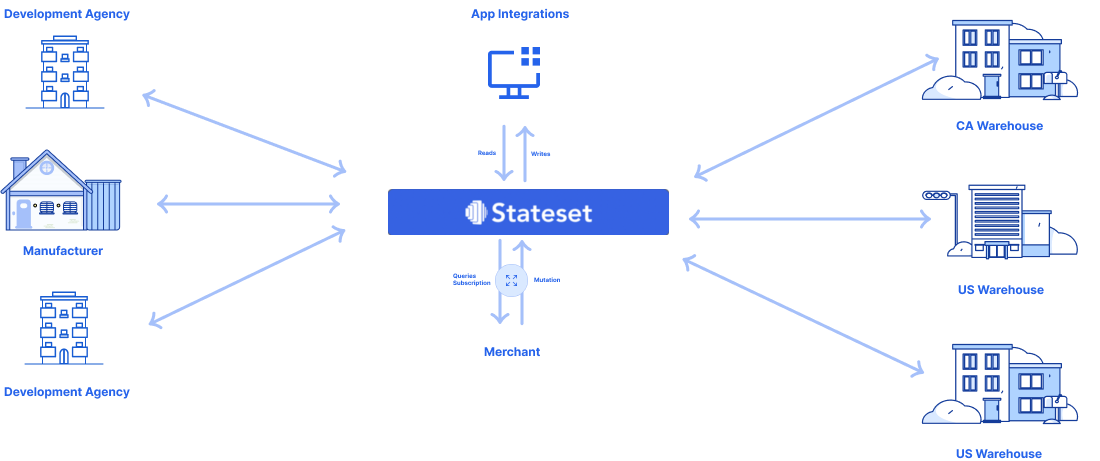
iCommerce is engineered as a layered, event-native operating system that sits above the merchant stack and transforms fragmented operations into closed-loop autonomous outcomes.
3.1 Key Architectural Tenets
- Outcome-contract driven: Every service, agent, and UI interaction binds to an AO contract that enforces lineage, guardrails, and profitability metrics.
- Human-controllable autonomy: Policy graph guardrails, Sentinel oversight, and co-pilot modes ensure operators can inspect, steer, or pause automation instantly.
- Extensible ecosystem posture: Canonical data, certified connectors, and marketplace governance invite partners while preserving compliance and trust.
3.2 High-Level System Architecture
Four cooperative planes deliver iCommerce capability:
- Experience & Outcome Plane: Generative, role-aware surfaces let humans interrogate, supervise, or co-create with agents in natural language while grounding every view in measurable Autonomous Outcomes.
- Intelligence & Agent Plane: Specialized reasoning agents operate as multi-agent teams with shared context, delegated responsibilities, and policy-aligned guardrails.
- Execution & Workflow Plane: Deterministic orchestration, transactional state management, and action services turn intent into cross-system API calls, messages, and human-in-the-loop escalations.
- Data & Integration Plane: A commerce-specific data fabric keeps every agent, workflow, and experience current with real-time, trusted data.
Cross-plane coordination is enforced through an AO contract: once an outcome is initiated, the Data Plane stamps lineage metadata, the Intelligence Plane binds plan ID and policy checks, the Execution Plane enforces deterministic retries and compensation, and the Experience Plane exposes explainability cards plus financial impact. This closed loop keeps humans in command while the system self-optimizes.
3.3 The Unified Data & Event Fabric
- Streaming connectors: MCP adapters, CDC pipelines, and streaming webhooks synchronize ERPs, WMSs, storefronts, PSPs, and support platforms with sub-50 ms p99 ingest-to-persist latency.
- Canonical commerce graph: Orders, fulfillment legs, payments, tickets, products, and inventory entitlements are mapped into a versioned knowledge graph that supports lineage, enterprise joins, and digital twin simulations.
- Real-time reasoning cache: A columnar, vector-augmented cache exposes semantic search, similarity lookups, and trend forecasts directly to agents without hitting source systems.
- Data quality & trust: Contracts, schema evolution, anomaly detection, and data residency policies are enforced at ingestion so operational decisions inherit trustworthy, auditable data.
- Lifecycle & stewardship: Tiered retention policies archive raw events after 30 days, persist canonical entities for 24 months, and cascade deletions across embeddings, memories, and logs.
- Lineage & accountability: Every event and derived feature carries a cryptographic lineage ID, enabling AO-level provenance reports that trace inputs, policy versions, and model fingerprints.
3.4 The Agentic Core: Reasoning and Execution
Autonomous outcomes are executed by teams of agents that blend symbolic guardrails with probabilistic reasoning.
- Role taxonomy: Coordinator agents perform task planning, Specialist agents execute domain workflows (orders, CX, inventory, finance), and Sentinel agents monitor outcomes for drift or risk.
- Cognitive loop: Each agent cycles through perception (context assembly via embeddings and canonical graph queries), deliberation (plan synthesis with tool-selection heuristics and policy checks), and action (deterministic tool execution with idempotent payloads).
- Shared memory: Conversation traces, outcome metrics, and feedback signals are stored in a multi-tenant memory service with granular retention controls to maintain personalization without data leakage.
- Safety envelope: Hard policies, constraint solvers, and simulation sandboxes validate high-impact actions (refunds, compliance filings) before agents execute them in production.
Agent teams coordinate via an AO mission plan. The Coordinator agent creates a DAG of required steps, registers it with the Workflow Plane, and attaches policy checkpoints and expected telemetry. Specialist agents claim steps asynchronously, emitting confidence scores and cost projections before execution. Sentinel agents watch the live DAG for anomalies, issuing slow-down, simulate, or abort directives if guardrails are breached.
3.5 Orchestration, State, and Execution Services
Temporal underpins the execution plane, but the implementation goes beyond workflow scheduling.
- Deterministic workflow mesh: Every AO decomposes into workflow primitives with explicit SLAs, rollback strategies, and compensation logic to keep multi-system processes consistent.
- Multi-region resilience: Active-active clusters, quorum-based state replication, and hot standby task queues protect against regional disruptions while preserving idempotency.
- Action services: Connector workers provide typed, rate-aware interfaces to external systems; command routers batch and order actions to respect partner SLAs and regulatory windows.
- Human-in-the-loop patterns: Approval, review, and annotation tasks are embedded as first-class activities so operators can intercept, edit, or guide agent actions without breaking determinism.
- Reliability playbooks: Automated health probes, brownout detection, and progressive rollouts (canary → shadow → full fleet) ensure new workflows or agent skills can be introduced and, if necessary, rolled back in under four minutes.
3.6 The Self-Learning & Optimization Loop
- Training harness: Supervised fine-tuning on synthetic and labeled transcripts establishes guardrail compliance; DPO aligns tone and policy adherence before live deployment.
- GRPO reinforcement: Group Relative Policy Optimization scores agent rollouts across quality, effort, and business KPI objectives, enabling targeted improvements without destabilizing production.
- Simulation & Scenario Labs: Synthetic marketplaces, stress tests, and historical replays evaluate new skills and policies prior to live release, producing readiness scores for leadership sign-off.
- Autonomous tuning: Bayesian optimizers adjust prompts, tool selection thresholds, and workflow policies based on rolling AO performance, while canary lanes catch regressions before wide rollout.
3.7 The Action, Insight, and Co-Pilot Plane
- Generative workspaces: React Server Components render contextual, ephemeral workspaces (investigate stockouts, audit returns) with drill-into agent reasoning and trace-level explainability.
- AO analytics: Every outcome feeds AO scorecards, profitability views, and what-if models so leaders can steer the business by outcomes rather than tickets.
- Co-pilot modes: Users can pair with agents, run in co-execution, or revert to manual control instantly. Voice, chat, and API surfaces all tap the same intent and policy engine.
3.8 Reliability, Observability, and Operational Excellence
- Observability fabric: Unified traces, structured logs, AO metrics, and golden signals stream into a time-series lakehouse with automated anomaly narratives.
- Policy-driven runbooks: Incident playbooks, kill switches, and safe-mode fallbacks ensure autonomy can be throttled without customer disruption.
- Compliance telemetry: Continuous controls monitor data access, retention, and regulated workflows; policy breaches raise Sev-0 alerts routed to the Governance Control Plane.
- SLO management: Every AO type, connector, and workflow has defined SLOs for success rate, latency, and cost per AO; Sentinel agents enforce error budgets and trigger throttling or human escalation.
3.9 Extensibility & Partner Ecosystem
- Connector SDK: Typed schema contracts, replay harnesses, and certification tests accelerate new integrations while protecting the canonical model.
- Outcome extensions: Partners can deploy custom AO types with pricing, guardrails, and analytics inherited from the core platform.
- Developer tooling: Local dev containers, workflow simulators, and policy linting help partner engineers ship safely; telemetry APIs expose usage and performance back to their teams.
- Marketplace governance: A three-tier certification program (Sandbox, Verified, Mission-Critical) enforces security scans, load testing, and policy compatibility so operators can trust third-party extensions.
- Cost-share visibility: Partner-built AOs publish cost/benefit telemetry into the AO scorecard, enabling brands to compare native vs. partner outcomes on equal footing.
4. Implementation and Value Realization
iCommerce deployments are structured as joint programs combining technical activation with organizational change management so autonomy arrives quickly and safely.
4.1 Activation Blueprint: Shadow to Autonomy
- Stage 0 — Readiness & Data Audit (Week 0): Catalog integrations, review policies, and run data-quality diagnostics. Scenario Lab simulations establish the baseline AO funnel and align success metrics.
- Stage 1 — Shadow Mode (Weeks 1–2): Agents observe real traffic, render proposed actions, and surface explainability traces inside the Action & Insight Plane. Differences versus incumbent processes are analyzed with operators.
- Stage 2 — Supervised Autonomy (Weeks 3–6): Agents execute low-risk AOs under human approval. Confidence scoring, guardrail tests, and incident playbooks are validated while training data is harvested for continuous learning.
- Stage 3 — Programmatic Expansion (Week 7+): High-confidence flows move to full autonomy with on-call oversight, while additional domains (finance, planning, logistics) enter the readiness cycle.
4.2 Delivery Workstreams
Four parallel workstreams keep technical and operational stakeholders aligned:
- Data & Integration Sprint: Stand up connectors, map the canonical commerce graph, define data contracts, and configure residency rules.
- Agent Enablement: Tailor prompts, tools, and guardrails per brand; seed memories with tone, SLAs, and policy playbooks; configure Sentinel monitors with target false-positive rate <5%.
- Operations Control: Calibrate the Governance Control Plane (policies, workflows, audit routing) and wire AO analytics into the executive dashboard.
- Change Management & Training: Upskill operators on co-pilot modes, issue new runbooks, and rehearse safe-mode transitions; track adoption via operator CSAT and co-pilot utilization (>70% target).
4.3 Measuring Success & Outcome-Based Pricing
We price on delivered Autonomous Outcomes, aligning incentives with customer value rather than license counts.
Annual Fee = Platform Base Fee + Σ (AO Type × Unit Price × Volume)
Representative AO catalogue:
| AO Type | Definition | Unit Price |
|---|---|---|
| Order.Processed | Order validated, paid, and routed with compliant fulfillment plan | $0.35 |
| Return.Initiated | Return authorized, RMA issued, disposition rules applied | $0.85 |
| Ticket.Resolved | Customer support inquiry resolved, transcript logged, CSAT captured | $1.25 |
| Subscription.Saved | Churn-risk subscription retained with approved incentive | $1.20 |
Unit pricing flexes by volume tiers and regulatory complexity. AO success, cycle time, and margin impact are monitored inside AO scorecards so the joint team can expand coverage confident that the economics work for both sides.
4.4 ROI Scenario: $50M Brand Illustration
The following snapshot models a typical brand migrating from a fragmented stack to iCommerce.
Annual Operations Snapshot
| Metric | Amount |
|---|---|
| Revenue | $50,000,000 |
| Orders | 125,000 |
| Average order value | $400 |
| Customer service tickets | 75,000 |
| Returns processed | 15,000 |
Legacy System + iPaaS + BPO Operational Costs
| Operational Cost | Amount |
|---|---|
| BPO/Support (20 FTEs) | $800,000 |
| Operations team (6 FTEs) | $600,000 |
| Software licenses | $400,000 |
| Integration/IT | $300,000 |
| Error-related losses | $500,000 |
| Total annual OpEx | $2,600,000 |
With the StateSet iCommerce Engine
| Component | Cost |
|---|---|
| Base iCommerce Engine fee | $60,000 |
| Order Outcomes (125K × $0.35 × 0.95) | $41,563 |
| Return Outcomes (15K × $0.85 × 0.90) | $11,475 |
| Ticket Outcomes (75K × $1.25 × 0.80) | $75,000 |
| Annual total | $188,038 |
Cost Reductions
| Savings Lever | Value |
|---|---|
| BPO reduction (85%) | -$680,000 |
| Operations efficiency (50%) | -$300,000 |
| Software consolidation | -$250,000 |
| Error elimination (90%) | -$450,000 |
Revenue Improvements
| Benefit | Value |
|---|---|
| Prevented stockouts | +$750,000 |
| Higher CSAT → LTV | +$500,000 |
| Faster processing | +$250,000 |
Summary Metrics
| Metric | Value |
|---|---|
| Total annual benefit | $3,180,000 |
| Annual investment | $188,038 |
| Net benefit | $2,991,962 |
| ROI | 1591% |
| Payback period | 0.7 months |
4.5 Post-Go-Live Maturity Sprints
Autonomy is not a single launch; it is a continuous maturity program. Every customer participates in rolling 90-day sprints that compound value.
- Sprint theme alignment: Each quarter maps to the maturity ladder, selecting 2–3 AO domains to expand and 1–2 guardrail or observability enhancements.
- Readiness gates: No new AO type proceeds to full rollout until Shadow variance <5%, Sentinel false-positive rate <2%, and AO profitability meets or exceeds forecast.
- Joint steering cadence: Monthly reviews inspect AO scorecards, policy incidents, and customer sentiment; quarterly business reviews update commercial commitments and roadmap priorities.
- Continuous enablement: Operator co-pilot labs, policy writing clinics, and Marketplace partner showcases ensure teams adopt new capabilities quickly.
- Value realization reporting: Finance dashboards reconcile AO invoices with realized savings/uplift, producing executive-ready ROI narratives aligned to board cycles.
Escalation matrix highlights: Severity 0 (policy breach, financial exposure) triggers immediate Sentinel lockdown, executive paging, and rollback to supervised mode; Severity 1 (degraded throughput) invokes runbooks within 15 minutes; Severity 2 (non-critical defects) enter the backlog with clear owners and ETAs.
4.6 Value Assurance & Cost Governance
Autonomy must remain economically aligned with the business. StateSet provides a shared Value Assurance Framework so finance, operations, and StateSet teams monitor performance together.
- AO budget guardrails: Each AO type has an agreed cost envelope (Cost per AO Plan ±5%). Sentinel agents watch envelopes in real time, triggering approvals if spend exceeds plan for more than 24 hours.
- Value attribution ledger: Every AO writes an entry capturing operational savings (labor, software, errors) and revenue uplift, using CFO-approved assumptions. Finance can drill from ledger entries to invoices for transparent reconciliation.
- Quarterly true-up: During QBRs, teams review AO coverage, margin contribution, and payback targets. Underperformance activates a joint remediation sprint; outperformance allows AO expansion or credit application against future outcomes.
- Scenario planning: Finance leaders run what-if analyses in the Action & Insight Plane to model cost and margin impact of adding new AO types, changing volume tiers, or adjusting policies before committing.
- Incentive alignment: StateSet incentives are tied to Net Value Delivered (benefit minus AO fees). If net value drops below the agreed threshold, escalation automatically routes to the Value Council for corrective action.
This framework ensures autonomy stays fiscally disciplined while giving executives the data needed to expand coverage confidently.
5. Security, Safety & Compliance: Designed for Trust
Security is designed into every layer of iCommerce so autonomy never compromises customer trust or regulatory standing.
5.1 Identity, Access & Policy Enforcement
- Enterprise identity: SAML/SCIM single sign-on with step-up MFA keeps administrative access under corporate control.
- Fine-grained authorization: Attribute-based access control (ABAC) allows policies on data residency, order value thresholds, or geography to govern both humans and agents.
- Session governance: Continuous risk assessment and least-privilege token issuance restrict tool access per workflow, with automatic revocation when policies change.
Key KPI: 100% of privileged actions include MFA evidence and policy graph evaluation, audited via the Trust Console.
5.2 Data Protection & Privacy
- Encryption: TLS 1.3 everywhere in transit, AES-256-GCM at rest, with hardware security modules safeguarding key material.
- Data residency & sovereignty: Regional deployment blueprints and “hold-your-own-key” options align with EU GDPR, UK DPA, and emerging state regulations.
- Privacy tooling: Self-service portals honor subject access, deletion, and opt-out requests while auto-redacting sensitive payloads from long-term memory stores.
Key KPI: Subject access/deletion requests fulfilled within 72 hours with validation logged in the audit ledger.
5.3 Platform Hardening & Runtime Safety
- Zero trust perimeter: Service-to-service communication is mutually authenticated and authorized; egress controls prevent data exfiltration.
- Secure SDLC: Threat modeling, dependency scanning, and supply chain attestations enforced via CI policies; infrastructure updates follow immutable build pipelines.
- Runtime monitoring: Container isolation, anomaly detection, red-team scenarios, and auto-quarantine flows stop malicious behavior from agents or connectors in real time.
Key KPI: Mean time to detect anomalies <2 minutes; mean time to contain <10 minutes.
5.4 Compliance & Assurance Roadmap
- Attestations: SOC 2 Type 1 complete; Type 2 audit underway (target Q4 2025). ISO/IEC 27001 certification targeted for H1 2026 with supporting ISMS already operational.
- Continuous controls: Automated evidence collection and policy-as-code checks keep audits low friction while informing internal stakeholders.
- Industry modules: PCI-DSS-aligned payments module, HIPAA-eligible deployment option, and MAP-compliant pricing workflows extend autonomy into regulated domains.
Key KPI: Automated evidence coverage ≥95% of required controls; audit readiness reviews pass with <5 minor findings per cycle.
5.5 Responsible AI Governance
- Explainability & auditability: Agent decisions include structured reasoning traces, tool calls, and policy verdicts for post-incident analysis.
- Bias & fairness guardrails: Evaluation suites monitor disparate impact across customer cohorts; Sentinel agents trigger reviews if variance exceeds tolerance.
- Model stewardship: Model cards, lifecycle documentation, and rollback plans ensure every model change is reviewable, reproducible, and reversible.
Key KPI: 100% of production model releases ship with model cards and bias evaluation summaries; variance stays within agreed thresholds (≤2%).
6. The Governance & Control Plane
Autonomy is sustainable only when humans can direct, inspect, and intervene at any time. The Governance & Control Plane is the command layer that keeps iCommerce aligned with brand policy, risk tolerance, and financial objectives. Leaders engage through daily Sentinel digests, weekly AO operations reviews blending finance and operations telemetry, and monthly Value Council sessions to evaluate scorecards, policy changes, and roadmap priorities.
6.1 Policy Graph & Guardrails
Policy authors express guardrails in natural language or structured DSL that compile into a policy graph. Rules can incorporate attributes such as geography, SKU class, AO cost ceilings, or customer lifetime value, and are versioned with approval workflows. Every agent plan is checked against the policy graph before execution, guaranteeing hard stops on non-negotiable constraints.
6.2 Workflow Studio & Experimentation
Operations teams design or modify workflows in a low-code studio backed by Temporal blueprints. Draft workflows run in Simulation Labs with synthetic or historical data and must pass canary tests before release. Variant testing (A/B or multi-armed bandits) is supported so teams can compare automations objectively and promote winning strategies safely.
Release KPI: ≥95% of releases complete Simulation Lab runs with variance <5% before promotion.
6.3 Trust Console & Audit Fabric
The Trust Console offers decision replay, timeline scrubbing, and impact analysis. Explainability cards show observed data, reasoning steps, policy checks, and executed tool calls. Root-cause insights and anomaly narratives accelerate resolution, while immutable logs integrate with SIEM or GRC tools to satisfy audit requirements.
Operational KPI: Decision replay coverage at 100% for high-impact AOs; median investigation time <15 minutes.
6.4 Change Management & Program Ownership
Role-based workspaces align executives, operators, and engineers. Release checklists, AO budgets, and kill switches are delegated by domain, making accountability explicit. When material changes occur, automated notifications request sign-off from finance, compliance, or regional leaders before agents receive updated capabilities.
6.5 Outcome Governance & Financial Controls
AO quotas, cost ceilings, and SLA targets can be set per region, channel, or product line. If an AO type drifts outside tolerance (cost per AO, success rate, margin contribution), Sentinel agents throttle automation and escalate to the owning leader. This closes the loop between autonomous execution and enterprise financial stewardship.
Financial KPI: AO cost variance remains within ±5% of plan; margin contribution tracked weekly to ensure autonomy stays accretive.
7. 12-Month iCommerce Engine Roadmap (Q3 2025 – Q2 2026)
The StateSet iCommerce Engine roadmap enhances autonomy, scalability, security, and developer extensibility. Each quarter advances a thematic pillar of outcome-driven autonomy.
7.1 Q3 2025 — Establish the Outcome Foundation
- Platform · FinOps Metering v1: Deliver usage and cost lenses per AO and tenant with 95% of production events cost-tagged; CFO dashboard live in three design-partner accounts. Dependency: finalize Kafka topic schema, secure BI bandwidth.
- ML Ops · Feature Store + Offline Eval: Ship Rust-backed feature store and pytest-style evaluation harness, reaching <2 hour feature rollout SLA and ≥5% offline F1 uplift. Dependency: GPU quota and data-governance approval.
- Trust & Compliance · Red-Team Playbook: Cover 100% of agent tool calls with jailbreak/function-abuse scenarios, closing Q3 with zero Sev-1 vulnerabilities. Dependency: dedicated security staffing.
7.2 Q4 2025 — Scale Autonomy & Resilience
- AI Agents · Planning & Logistics GA: Launch demand-forecasting and 3PL-routing agents achieving ≤8% MAPE and 20% split-shipment reduction across two pilot brands. Dependency: reliable WMS inventory feeds.
- Resilience · Chaos-Testing Playbooks: Validate Kubernetes and Temporal failure modes with GameDay exercises proving <5 minute MTTR. Dependency: staging cluster capacity.
- Trust & Compliance · SOC 2 Type 2 Kickoff: Complete gap analysis and remediation sign-off to keep assurance timeline on track. Dependency: external auditor availability.
7.3 Q1 2026 — Open the Developer Ecosystem
- Developer Ecosystem · Plug-in SDK v1: Release type-safe Rust and JS SDKs with sandbox + documentation, onboarding ≥5 external extensions into Marketplace beta. Dependency: DevRel hiring and marketplace billing backend.
- Platform · Network Benchmark Beta: Instrument per-tenant latency and throughput canaries with alerting on SLA breaches, providing transparent ingest-to-persist visibility. Dependency: feature-flag library upgrade.
- Trust & Compliance · SOC 2 Type 2 Report: Publish unqualified opinion with zero critical remediation items, supported by automated evidence pipelines. Dependency: timely cross-team evidence collection.
7.4 Q2 2026 — Optimize Revenue & Reliability
- AI Agents · Pricing & Promotions GA: Deliver dynamic pricing/promo agent generating ≥3% gross-margin lift in pilot cohort while maintaining zero audited rollbacks. Dependency: competitive-price feeds and MAP legal review.
- Resilience · Active-Active DR Roll-out: Achieve RPO <30 seconds and RTO <5 minutes during live failover drills across multi-region PostgreSQL and Temporal. Dependency: cloud quota and data-sovereignty clearances.
- Developer Ecosystem · Marketplace GA: Launch outcome marketplace with ≥25 certified plug-ins and $250K GMV run rate, catalyzing partner-led AO innovation. Dependency: payment gateway integration.
8. Conclusion: The Future is Autonomous
The iCommerce Engine proves that autonomy does not require sacrificing control. A four-plane architecture keeps experiences, intelligence, execution, and data tightly aligned so every decision is context-rich, auditable, and economically sound. Multi-agent teams reason over a canonical commerce graph, Temporal-backed workflows guarantee deterministic completion, and adaptive learning continuously sharpens outcomes. Governance, observability, and safety features ensure leaders can expand automation with confidence, pausing or reconfiguring it whenever conditions change. With outcome-based pricing, brands capture measurable ROI from day one while building a resilient operating model that compounds over time.
Immediate Next Actions
- Form a joint Value Council with StateSet, appoint executive sponsors, and approve the AO scorecard template (Appendix D).
- Complete the Readiness checklist (Appendix A) and schedule a Scenario Lab session to baseline AO coverage and variance.
- Prioritise the first AO domains (e.g., Order.Processed, Ticket.Resolved) and align success targets, cost envelopes, and guardrails in Section 4.6.
- Plan the initial roadmap checkpoint using Section 7 to align your launch window with upcoming platform capabilities.
9. Glossary & Acronym Index
- AO (Autonomous Outcome): A discrete, successful business result executed by the iCommerce Engine without human intervention; also the basis of pricing.
- AO Scorecard: Executive dashboard tracking AO coverage, decision confidence, guardrail adherence, and payback metrics.
- AO Contract: Cross-plane agreement binding data lineage, policy checks, workflow SLAs, and experience explainability for each outcome.
- Value Assurance Framework: Joint governance model aligning AO cost envelopes, benefit tracking, and remediation playbooks between StateSet and the customer.
- Value Council: Executive steering group spanning StateSet and customer leadership that reviews AO economics, approves expansion, and resolves escalations.
- Scenario Labs: Simulation environment used during activation to replay historical data, stress-test policies, and benchmark AO variance before production rollout.
- SDK (Software Development Kit): Tooling that allows developers to create applications or connectors for the platform.
- Sentinel Agent: Supervisory agent class that monitors outcomes, policy compliance, and anomaly signals, triggering interventions when thresholds are breached.
- SFT (Supervised Fine-Tuning): Adapting a pre-trained model to a specific task with labeled data.
- SOC 2: Compliance standard specifying how organizations should manage customer data.
- Temporal: Durable, highly reliable workflow-orchestration engine used for stateful operations.
- VDB (Vector Database): Stores numerical representations of data and metadata for retrieval-augmented applications.
- WMS (Warehouse Management System): Software that supports and optimizes warehouse functionality and distribution center management.
Appendices
Appendix A: Reference Deployment Checklist
Stage 0 — Readiness
- Executive sponsor and program charter confirmed; budget tagged to AO outcomes.
- System inventory captured with data-classification map and residency requirements documented.
- Governance council formed (operations, finance, compliance, engineering) with cadence agreed.
- Success metrics baselined: AO coverage, cycle time, cost-to-serve, CSAT, policy incident rate.
- Data contracts and retention policies (raw events 30 days, canonical 24 months) reviewed with security and privacy leads.
Stage 1 — Shadow Mode
- Connectors deployed in read-only posture with schema validation and data-quality monitors enabled.
- Trust Console activated to compare incumbent vs. agent recommendations; variance thresholds set.
- Policy graph seeded with non-negotiables (refund limits, fraud tolerances, brand tone) and signed off.
- Shadow variance <10% and decision confidence tracked; Sentinel alerts tuned to maintain false-positive rate below 5%.
Stage 2 — Supervised Autonomy
- Human-in-the-loop queues configured with SLA alerts; Sentinel monitors tuned to escalation pathways.
- AO analytics embedded in leadership dashboards; finance signs off on AO invoicing workflow.
- Incident playbooks rehearsed (kill switch, safe-mode operations, manual override) with runbook owners assigned.
- Operator readiness assessed via co-pilot utilization survey and training completion (>80% threshold).
Stage 3 — Full Autonomy & Expansion
- Active-active failover tested; recovery objectives documented and approved by security.
- Co-pilot training completed for operators; feedback loops established for prompt/policy updates.
- Marketplace extension backlog prioritized with partner enablement plan and certification criteria.
- Quarterly maturity sprint themes agreed with measurable AO coverage, guardrail, and margin targets.
Appendix B: Technical Specifications
Infrastructure Requirements
- Cloud-agnostic (AWS, GCP, Azure supported)
- Kubernetes-based deployment
- PostgreSQL for transactional data
- GCS / S3-compatible object storage
- Kafka or Pulsar for event streaming
Performance Specifications
- Event processing: 1M+ events/second
- API latency: <50 ms p99
- Workflow throughput: 100K+ concurrent
- Data freshness: <100 ms end-to-end
- Availability: 99.95% SLA
Integration Capabilities
- REST API with OpenAPI 3.0 specification
- GraphQL endpoint for flexible queries
- Webhook support for real-time events
- SDK availability: Rust, Python, JavaScript, Go, Java
- CLI tool for developers
Appendix C: ROI Calculation Worksheet
Use this framework to calculate your potential ROI.
Current Annual Costs
- A. Labor (FTEs × Salary): $_______
- B. Software Licenses: $_______
- C. Integration/IT Support: $_______
- D. Error-Related Losses: $_______
- E. Opportunity Cost (est.): $_______
- Total Current Cost: $_______
iCommerce Investment
- F. Annual AO Fees: $_______
- G. Implementation (one-time): $_______
- Total Investment: $_______
Expected Benefits
- H. Labor Reduction (A × 70%): $_______
- I. Software Consolidation (B × 60%): $_______
- J. Error Reduction (D × 90%): $_______
- K. Revenue Uplift (Revenue × 2%): $_______
- Total Annual Benefit: $_______
ROI Calculation
- Annual Net Benefit: (H + I + J + K) – F = $_______
- ROI Percentage: (Net Benefit ÷ F) × 100 = _____%
- Payback Period: G ÷ (Monthly Net Benefit) = ____ months
Appendix D: Sample AO Scorecard
Use this template during monthly steering sessions. Metrics shown reflect the illustrative $50M brand.
AO Performance
| Metric | Target | Actual |
|---|---|---|
| AO coverage (core domains) | ≥ 90% | 92% |
| Decision confidence (actions above threshold) | ≥ 97% | 97.8% |
| Guardrail overrides per 1,000 AOs | ≤ 3 | 1.1 |
| Rollback rate | ≤ 0.5% | 0.2% |
Financial Outcomes
| Metric | Target | Actual |
|---|---|---|
| Cost per AO (blended) | $0.65 | $0.62 |
| Net benefit run-rate | $250K / month | $265K / month |
| Margin contribution delta | ≥ +5% | +6.3% |
Operational Health
| Metric | Target | Actual |
|---|---|---|
| Incident MTTR (Severity 1) | ≤ 30 min | 22 min |
| Sentinel false-positive rate | ≤ 5% | 3.4% |
| Model release compliance (docs + bias eval) | 100% | 100% |
Customer Experience
| Metric | Target | Actual |
|---|---|---|
| CSAT after AO interaction | ≥ 4.6 / 5 | 4.7 / 5 |
| NPS delta vs. baseline | ≥ +8 | +9 |
| First-contact resolution | ≥ 92% | 94% |
Share the scorecard with finance, operations, and StateSet during the steering cadence to affirm value realization, approve AO expansion, or trigger corrective sprints.
References
- StateSet. (2025). iCommerce Engine: An Architectural Blueprint for Autonomous Commerce Operations (Version 1.1, July 20 2025). StateSet, Inc.
- Schulman, J., Wolski, F., Dhariwal, P., Radford, A., & Klimov, O. (2017). Proximal Policy Optimization Algorithms. arXiv:1707.06347.
- Yuan, L., Wang, Z., & Li, Q. (2024). Group Relative Policy Optimization: Stabilizing Multi-Objective Reinforcement Learning. Proceedings of ICML 2024.
- Temporal Technologies. (2023). Temporal: A Durable, Fault-Tolerant Workflow Orchestration Engine. https://temporal.io
- American Institute of Certified Public Accountants (AICPA). (2022). SOC 2®—Trust Services Criteria. AICPA.
- International Organization for Standardization (ISO). (2022). ISO/IEC 27001:2022—Information Security, Cyber-security and Privacy Protection — Information Security Management Systems. ISO.
- Google AI. (2023). Bayesian Optimization in Practice: Automated Hyper-parameter Tuning for Large-Scale Machine-Learning Pipelines. Google AI Blog.
- Patterson, D., et al. (2021). Carbon Emissions and Large Neural Networks: A Systematic Study. arXiv:2104.10350.
- CISA & NIST. (2023). Supply-Chain Risk Management Practices for Cloud-Native Architectures. U.S. Cybersecurity & Infrastructure Security Agency.
Enjoyed this article?
Get more insights on autonomous commerce, AI agents, and margin intelligence delivered to your inbox.