Introducing StateSet iCommerce OMS, WMS, and TMS
A connected foundation for orders, inventory, and transportation.

StateSet Team
Product & Engineering
An order is placed. Inventory needs to be reserved. A warehouse needs to pick and pack the right units. A carrier needs to collect the shipment, deliver it, and submit the right charges. For the customer, this is one purchase. For the operations team, it can mean several systems, separate records, and a long chain of follow-up.
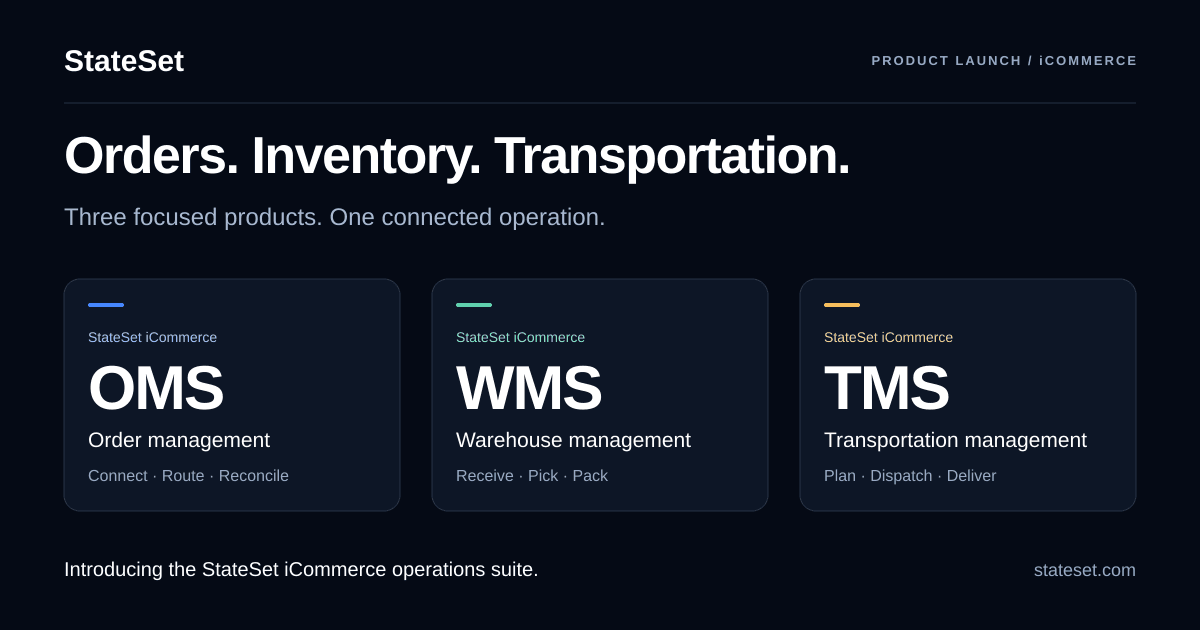
Today, we’re introducing StateSet iCommerce OMS, StateSet iCommerce WMS, and StateSet iCommerce TMS: three focused products for the operational work behind commerce.
OMS coordinates orders and connected systems. WMS manages physical inventory and warehouse execution. TMS manages transportation and freight obligations. Together, they extend the StateSet iCommerce vision across the order lifecycle, the warehouse floor, and the freight network.
StateSet Sync is now iCommerce OMS
The product previously known as StateSet Sync is now StateSet iCommerce OMS. The name reflects its role in the suite: managing the flow of orders across sales channels, inventory sources, ERPs, and fulfillment partners.
Commerce teams need to know what was ordered, which systems have received it, where fulfillment stands, and what needs attention. OMS brings that work into a shared operational view, preserving channel references and connecting the order to its jobs, fulfillment updates, and history.
- Connect sales channels. Ingest orders through webhooks and scheduled synchronization, with supported integrations spanning storefronts and marketplaces.
- Coordinate inventory and fulfillment. Track availability and reservations, route orders to configured destinations, and connect ERP and fulfillment workflows.
- Recover interrupted work. Inspect failed jobs, retry eligible operations, and replay events with retained history and duplicate protection.
- Bring outcomes back to the order. Connect shipment status and tracking with the original commercial record.
OMS builds on the integrations and orchestration developed in Sync. It gives brands a way to coordinate their existing systems while making the order lifecycle easier for operators and agents to follow.
iCommerce WMS: every unit accounted for
StateSet iCommerce WMS, developed in the StateSet Warehouse project, manages the physical side of fulfillment: receiving, putaway, allocation, picking, packing, shipping handoffs, returns, counts, and facility transfers.
A warehouse record needs to correspond to something that actually happened. Stock arrived at a receiving location. An operator moved it into storage. An order reserved it. A picker collected it. A packed shipment left with a carrier. WMS retains that sequence through an immutable movement history.
That foundation supports the daily work of a facility:
- Receive and store accurately. Work from expected receipts, validate bin, SKU, and lot identity, and direct stock into storage.
- Execute fulfillment. Reserve inventory by order line, retain backorders, batch picks, and record packing and carrier handoffs.
- Trace physical inventory. Follow lots and serials, apply expiry and quarantine controls, and track transfers between facilities.
- Resolve discrepancies. Replenish pick locations, perform cycle counts, recover short picks, and reconcile balances against movement history.
Returns are tied to the original shipped units. Retried commands retain their original request identity. Missing or ambiguous evidence holds the affected work for review. These details matter because an inventory decision becomes a physical commitment on the warehouse floor.
iCommerce TMS: connect the shipment to its obligations
StateSet iCommerce TMS, developed in the StateSet Freight project, gives shippers, brokers, and carriers a shared shipment record across planning, carrier tenders, dispatch, tracking, delivery, and freight finance.
The transportation lifecycle starts with a plan: the customer, lane, stops, equipment, and agreed rates. It continues through carrier acceptance, driver and equipment assignment, pickup, and delivery evidence. The same record provides context when finance reviews the freight bill.
- Plan and tender. Define transport requirements and agreed buy and sell rates, then manage carrier tenders and acceptance.
- Dispatch and track. Assign eligible drivers and equipment, check active-load conflicts, and record shipment milestones.
- Retain delivery evidence. Connect pickup events, stop confirmations, location updates, and proof of delivery to the shipment.
- Audit and reconcile. Review carrier invoices, manage customer billing, prepare settlement obligations, and reconcile externally cleared payments.
Freight finance stays connected to the transport work it represents. Settlement preparation records an obligation; it does not initiate a bank transfer. Freight billing also stays separate from the upstream product-order total.
One order, three clear responsibilities
Consider an order that needs to leave a warehouse and travel to a customer. OMS coordinates the commercial demand and its connected systems. WMS allocates the stock, records the physical work, and preserves the carrier handoff. TMS manages the transportation plan, delivery milestones, and freight obligations.
The handoffs matter as much as the individual steps. A packed order and a shipped order describe different events. A planned pickup and a confirmed pickup carry different evidence. An approved carrier bill and a cleared payment are separate records.
The suite is designed around those distinctions. Configured integrations carry source records and explicit status between systems, giving each product a defined responsibility. Connections must be validated for the customer’s environment, including tenant mappings, receiver capabilities, and recovery behavior.
A foundation for operators and AI agents
Useful automation depends on the same things an experienced operator needs: current context, clear authority, and a reliable record of what has already happened.
The products expose APIs and agent interfaces alongside their operator tools. OMS provides operational briefings and integration controls. WMS exposes warehouse commands through its API and native MCP server. TMS provides an API and MCP adapter for shipment workflows. Each product applies its own role, confirmation, and command controls.
This gives agents a structured way to participate in commerce operations, while preserving the records and review points that teams need to understand the outcome.
Launch rates and monthly commitments
Our pricing model ties usage to completed work: customer issues resolved, original orders orchestrated, warehouse fulfillment completed, and parcels dispatched. It also includes StateSet iCommerce CX, where completed customer issues are classified by outcome.
| Offering | Primary billing unit | Launch rate | Monthly commitment |
|---|---|---|---|
| StateSet iCommerce CXScoped rollout | Completed customer issue, classified by outcome | $0.75 informational resolution$1.75 voice informational resolution$2.50 commerce outcome$3.00 financial outcome | $1,000/account |
| StateSet iCommerce OMSScoped rollout | Original order successfully orchestrated to the agreed fulfillment milestone | $0.10/order | $1,000/account |
| StateSet iCommerce WMSEarly access · Facility pilot | Completed fulfillment of an original order at a physical warehouse | $0.20/order per warehouse involved | $2,500/live warehouse |
| StateSet iCommerce TMS — ParcelEarly access · Scope confirmation | Parcel actually dispatched | $0.05/parcel | $500/account |
| StateSet iCommerce EDIPartner qualification | Agreed trading-partner, document-volume, and service scope | Custom quoteScope your EDI quote | Custom commitment |
| StateSet iCommerce TMS — FreightEarly access · Developer alpha | Agreed freight workflows, modes, and pilot scope | Custom quoteScope your freight quote | Custom commitment |
Scoped rollout
- Primary billing unit
- Completed customer issue, classified by outcome
- Launch rate
- $0.75 informational resolution$1.75 voice informational resolution$2.50 commerce outcome$3.00 financial outcome
- Monthly commitment
- $1,000/account
Scoped rollout
- Primary billing unit
- Original order successfully orchestrated to the agreed fulfillment milestone
- Launch rate
- $0.10/order
- Monthly commitment
- $1,000/account
Early access · Facility pilot
- Primary billing unit
- Completed fulfillment of an original order at a physical warehouse
- Launch rate
- $0.20/order per warehouse involved
- Monthly commitment
- $2,500/live warehouse
Early access · Scope confirmation
- Primary billing unit
- Parcel actually dispatched
- Launch rate
- $0.05/parcel
- Monthly commitment
- $500/account
Partner qualification
- Primary billing unit
- Agreed trading-partner, document-volume, and service scope
- Launch rate
- Custom quoteScope your EDI quote
- Monthly commitment
- Custom commitment
Early access · Developer alpha
- Primary billing unit
- Agreed freight workflows, modes, and pilot scope
- Launch rate
- Custom quoteScope your freight quote
- Monthly commitment
- Custom commitment
StateSet iCommerce EDI is available through a custom quote covering trading partners, document volumes, transport, onboarding, and service scope. EDI rates, commitments, and shared-credit eligibility are agreed separately; EDI charges are excluded from the numerical examples below. Request an EDI quote.
These are our launch rates and entry commitments; final terms are confirmed in your order form. Each enabled product contributes to one shared dollar balance across CX, OMS, WMS, and Parcel TMS. The commitment covers consumption: a $5,000 monthly commitment covers the first $5,000 of eligible usage. With no opening credits, the software bill is the greater of the monthly commitment and consumed service value.
The standard agreement is 12 months, funded monthly, with 90-day rollover of unused credits and oldest credits used first. The minimum remains due even at zero usage, and unused credits can expire. Negotiated discounts reduce unit rates while the contracted spending floor stays unchanged. Existing agreements retain their contracted terms.
CX uses one highest applicable tier per distinct completed issue. OMS counts an original order reaching its agreed fulfillment milestone. WMS counts completed fulfillment once per original order at each physical warehouse involved; multiple picks or parcels at the same warehouse add no units. Parcel TMS counts actual dispatch, excluding voided and unshipped labels. Internal calls, duplicate events, and retries do not create extra units.
For the sample month of 25,000 OMS orders, 25,000 WMS fulfillments, 27,500 dispatched parcels, and separate CX issues comprising 2,000 informational resolutions, 400 commerce outcomes, and 100 financial outcomes, consumed service value is $11,675. With CX, OMS, WMS, and Parcel TMS, one warehouse, and no opening credits, that includes the $5,000 commitment plus $6,675 in additional usage.
Supported onboarding, standard integrations, and standard support are included within agreed scope. Exceptional implementation work is scoped separately. Postage, freight, insurance, duties, hardware, and physical warehouse operations are separate from software pricing. LTL, truckload, complex B2B, and advanced warehouse workflows require their own scope and quote.
Explore the full rate card and calculate your monthly estimate, or compare CX with your current customer-service operation.
Explore the products and plan your rollout
Start with the part of your operation you want to improve. For OMS, that means mapping channels, inventory ownership, ERP connections, and fulfillment destinations. For WMS, it means validating facilities, scanners, labels, and the work performed on the floor. For TMS, it means reviewing lanes, carriers, dispatch requirements, and freight finance.
WMS has completed local software qualification; production deployment, scanner hardware, and physical facility acceptance still require validation. TMS is in developer alpha, with production capacity, live identity setup, and dispatcher acceptance still to be qualified. Integrations across the suite require configuration and validation before live use.
Explore the new product pages or book a walkthrough with the StateSet team to discuss your operation and a rollout plan.